A beginner lifting program
The first 12 weeks, with the math written out
Three days a week, six lifts, one rule for when to add weight. You can run it on paper. The rule is the same one Myomap’s engine runs, written out so you can check it rather than trust it.
See the program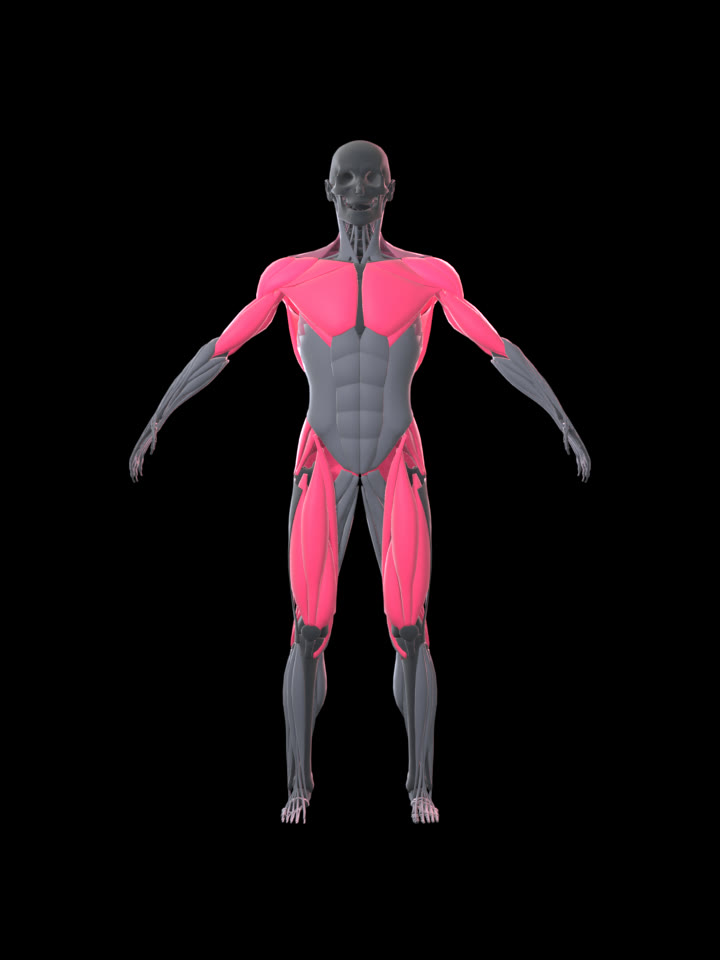
The program
The same six lifts, three days a week.
Any three non-consecutive days · Mon / Wed / Fri works
-
 Squat goblet or barbell
quads · glutes
3×5–8
-
 Bench press or push-up
chest · shoulders · triceps
3×5–8
-
 Row dumbbell, cable or machine
back · biceps
3×8–12
-
 Romanian deadlift
hamstrings · glutes
2×8–12
-
 Overhead press
shoulders · triceps
2×5–8
-
 Lat pulldown or assisted pull-up
back · biceps
2×8–12
Leave 1–2 reps in the tank. If you could not have done at least one more, you went too heavy. At this stage repetition is the point — you are learning the movements while you add weight to them.
The rule
Reps first.Then weight.
Start at a weight you can do for 5 clean reps on all sets.
Each session, try to add one rep to each set, same weight.
When you hit the top of the range on every set — 8, 8, 8 — add weight next session.
Adding weight drops you back to the bottom of the range. That is correct and expected. Climb again.
Worked example
Six sessions of bench press, rep by rep.
-
95lbReps: 5 · 5 · 5Session 1Add a rep
-
95lbReps: 6 · 6 · 5Session 2Add a rep where you can
-
95lbReps: 7 · 6 · 6Session 3Keep going
-
95lbReps: 8 · 8 · 7Session 4Not yet — one set is short
-
95lbReps: 8 · 8 · 8Session 5Every set at the top: add weight
-
100lb+5Reps: 6 · 5 · 5Session 6Back to the bottom. Correct.
Adding weight every session is the standard beginner advice and it works until it doesn’t — usually week 4 or 5, when the jumps outrun what you actually recovered from, form degrades, and you stall on a weight you never really owned. Reps-then-weight means you only ever add load you have already earned at the rep you earned it, so the stall arrives later and is real information when it does.
When you stall
A stall is two sessions in a row with no rep added anywhere on a lift.
Repeat the weight a third time. Stalls are often sleep or food, not strength.
Cut that lift’s weight by 10% and climb back. You will usually pass the old number within 2–3 weeks. This is a deload, a normal part of the program, not a failure of it.
That lift is the problem, not your recovery. If the rest are climbing, check your form on it before you cut anything.
Food, briefly
You do not need to track anything for this to work.
If you want the simple version: eat roughly 0.7–1 g of protein per pound of bodyweight a day, and if the scale has not moved in three weeks and you want it to, eat a bit more of everything. That is the whole of it at this stage.
What not to do
Don’t change the program. Twelve weeks of these six lifts beats twelve weeks of variety. Novelty feels like progress and isn’t.
Don’t add “one more exercise.” If you have energy left, you were too light.
Don’t max out to see where you are. The log tells you where you are.
Don’t skip the write-down. Weight and reps for every set, every session. Without it the rule has nothing to run on — you are guessing, which is the thing this replaces. Print the log sheet.
Where this came from
The single loudest complaint was apps whose “AI” reshuffles your workout every week without explaining itself. The second, smaller but sharper: being made to do the progression math yourself.
“changes workouts every week and yes this will SLOW DOWN MUSCLE GROWTH”App Store review
“the ‘AI’ just shuffles workouts with no rhyme or reason”App Store review
So the rule above is deliberately boring, deterministic, and short enough to check.
You should be able to predict what your program tells you to do next week. If you can’t, it isn’t coaching you — it’s shuffling.
If you want it run for you
The same rule, run for you.
The program works on paper and we would rather you used it that way than installed anything. If you want it run for you — the log, the rep-by-rep arithmetic, the deload trigger, and a plain-English “why” on every change — that is what Myomap is for. It is free.
Get Myomap App Store iPhone · free